Sculptra occupies a distinct category within injectable treatments. While dermal fillers use Hyaluronic Acid (HA) to temporarily plump the skin, Sculptra is a collagen biostimulator that works at the deep dermis level where your collagen and elastin live. This prompts the body to build and rebuild its own collagen framework. This is a restorative, foundation-first approach rather than a volumising one, which is why we position it differently from conventional fillers. People don’t choose Sculptra to dramatically change how they look; they choose it to restore how their face used to look.
Sculptra treatments work differently because instead of introducing volume, it stimulates the body’s own collagen production. Results develop gradually rather than immediately, but the volume that emerges is your own tissue and tends to last well beyond what traditional dermal filler treatments can offer.
This guide covers everything you need to know about Sculptra: how it works, how it compares to other injectables, who it’s right for, and what to expect before, during, and after your treatment session.
What is Sculptra and How Does It Work?
Sculptra is an injectable collagen biostimulator made from poly-L-lactic acid, or PLLA. It’s a biocompatible, biodegradable material that has been used in medicine for decades, including in dissolvable sutures. For cosmetic use, it’s been Health Canada and FDA-approved since 2006.
When injected, the PLLA microparticles in Sculptra trigger a natural process called collagenesis: your body’s own collagen production response. Your immune system recognizes the PLLA particles, sends fibroblasts (the cells responsible for producing collagen) to the area, and those fibroblasts get to work building new collagen and elastin fibers beneath the skin.
As the new tissue matures, the skin becomes measurably thicker, firmer, and more voluminous. This happens because the structural change is real, not introduced. This stimulation remains active for up to 25 months after the treatment protocol, and the clinical distinction is straightforward: there is no temporary product to maintain, only the structural foundation the body has produced for itself.
Beyond volume, the collagenesis occurring beneath the dermis improves overall skin quality. Measurable gains in tone, laxity, and pigmentation become more noticeable as the treatment progresses.
For those who want the clinical research behind Sculptra: PMC Biostimulator Clinical Study | PMC Clinical Research — PLLA and Collagenesis | PMC Additional Clinical Evidence | Randomized Controlled Clinical Trial (PubMed) | FDA Expanded Approval Documentation
*Results may vary. Individual outcomes depend on age, skin condition, lifestyle, and treatment protocol.
Is Sculptra a Filler? Understanding Biostimulatory Fillers
Technically, yes. Sculptra is classified as a dermal filler, but it sits in a different category from the HA fillers most people think of when they hear the term.
HA fillers, such as Juvéderm and Restylane, attract water to the injection site to create immediate, visible volume. They are well-suited for targeted correction and are fully reversible. Sculptra works differently. It adds no immediate volume and leaves no product residing in the tissue long term; instead, it stimulates the body to produce its own collagen over time. The accurate term for this type of product is biostimulatory filler.
The practical difference: HA fillers produce a visible change on the day of treatment, whereas Sculptra produces no immediate change, with the exception of mild swelling from the procedure, with results unfolding gradually over the following months. This gradual timeline of this treatment means your work is undetectable to even the most discerning eye.
It’s also worth knowing that the two are not mutually exclusive. Many treatment plans use Sculptra as the foundation (restoring broad volume and structural support) and HA fillers for more targeted refinements once that foundation is in place.
If you’re looking for a full breakdown on how these types of injectables compare, learn more here: Filler vs. Sculptra: What’s the Difference?
Radiesse or Sculptra: Which Biostimulator Is Right for You?
Once you understand how biostimulators work, you may wonder why we might choose Sculptra over another popular option like Radiesse. Both are biostimulatory injectables, both stimulate collagen, and both deliver long-lasting, beautiful outcomes. The difference lies in their chemical composition, immediate behaviour in the tissue, and where they perform best.
At Juvea Aesthetics, we use both options frequently and treat them as complementary tools. Our choice between them is always strategic, and we consider your unique anatomy, your degree of volume loss, and the specific areas we are addressing.
Feature | Sculptra | Radiesse |
|---|---|---|
Immediate Effect | None. Full results emerge gradually over time. | Immediate physical lift and contour. |
How It Works | Gradually triggers full natural volume. | Dual-action: instant mechanical lift paired with long-term collagen growth. |
Best For | Broad facial hollowing, temples, mid-face, select body contours such as the buttocks, and improving skin texture including cheek wrinkles. | Sharp jawlines, hands, and neck tightening. |
Typical Protocol | 1 to 2 sessions (rarely 3, spaced 4 weeks apart). | 1 to 2 sessions, depending on the goal. |
Longevity | Visible stimulation can continue for up to 25 months. | 12 to 18 months. |
Why Clients Choose Sculptra: People love Sculptra for facial restoration because it’s completely undetectable. The volume builds slowly over weeks, and you’ll never experience a dramatic change in your appearance. You’ll look like you have regained the healthy facial density of your past, making it the ultimate secret for natural aging.
Learn more about which biostimulator is right for you here: Radiesse vs. Sculptra: Which Biostimulator Is Right for You?
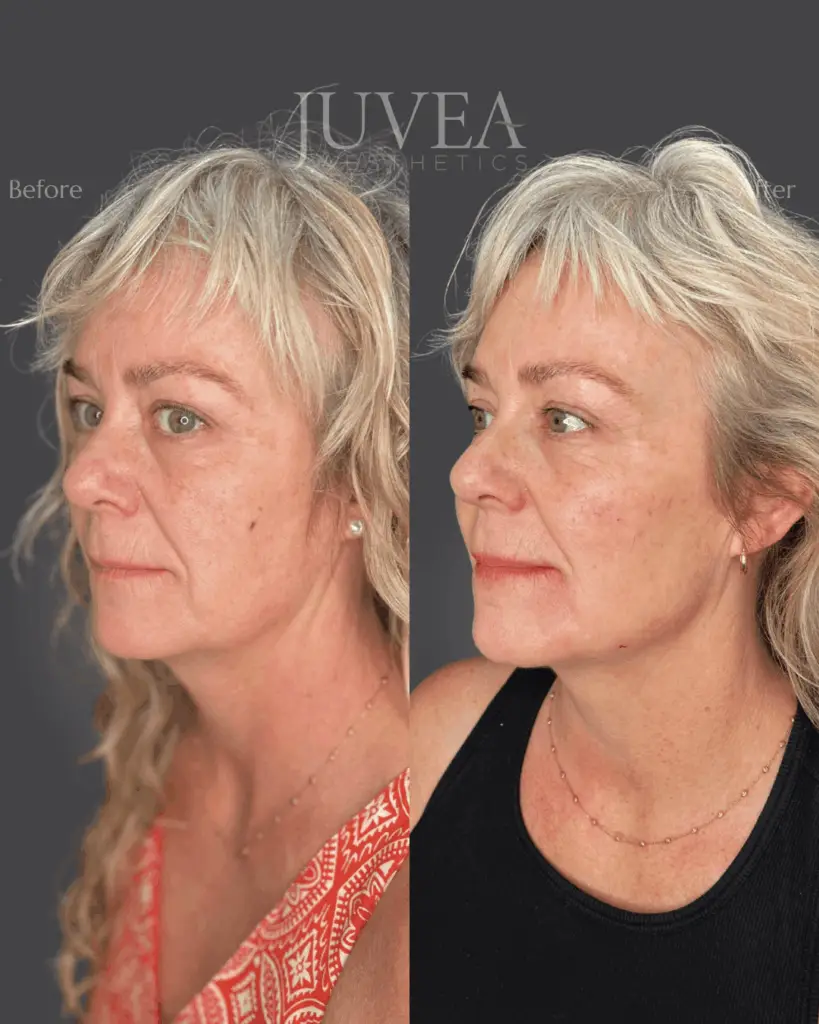
Before and After
Sculptra results unfold gradually over several weeks, creating a soft “pull-back” lifting effect and a radiant skin glow built entirely by your own collagen.
What Areas Can Be Treated With Sculptra?
Sculptra works on both the face and the body. The principle is the same across all areas: rebuilding collagen gradually to improve structure, volume, and skin quality from within. Here are the areas we most commonly treat with Sculptra.
Sculptra for the Face
Facial volume loss begins earlier than most people realize, typically in our mid-20s and accelerating through our 30s and 40s. By the time visible changes appear at the surface, significant support has already been lost underneath.
Treatment Area | How Sculptra Helps | Visual Outcome |
|---|---|---|
Mid-Cheek | Rebuilds the foundational support that deflates over time, or due to loss of volume from GLP-1s such as Ozempic. | Restores natural fullness and prevents the lower face from flattening and visibly improves cheek wrinkles and skin quality in the area.
|
Temples | Fills in the hollow, concave areas on the sides of the upper face. | Rebalances facial proportions and restores lost volume to the upper face for a less gaunt, more youthful appearance. |
Pre-Auricular Area | Restores the transition zone directly in front of the ears. | Rebuilds early volume loss to smooth out the facial borders. |
Jowling & Jawline | Lifts the area indirectly by treating the cheeks and anchor points above. | Softens the look of jowls and creates a more defined jawline over time. |
Nasolabial Folds & Marionette Lines | Rebuilds structural support higher up in the face. | Naturally smooths the deep lines running around the nose and mouth for a softer, more rested appearance. |
Non-Surgical Butt Lift (BBL) | Stimulates deep structural collagen production directly within the gluteal tissue layers. | Gradually enhances natural fullness, smooths the skin texture, and improves overall contour. |
If these concerns apply to you, or you have other areas to address, a consultation is the best next step. We’ll assess your anatomy and build a treatment plan specific to your structure and goals.
Reversing “Ozempic Face” Volume Loss
GLP-1 medications like semaglutide (Ozempic, Wegovy) have become widely used for weight management. Significant weight loss, especially when it happens quickly, can accelerate facial volume loss. Clients often describe looking older or describe a more hollowed or aged facial appearance, even as body composition changes as intended.
Sculptra has become one of the most requested treatments for this because it rebuilds volume gradually through collagen stimulation. Clients don’t go from depleted to obviously filled; they beautifully recover their original facial proportions through a seamless progression.
If you’re currently on or have recently come off a GLP-1 medication and have noticed changes in your face, a consultation with us allows us to build a plan calibrated to your stage in that process.
Butt Lift, Hip Dips, and Cellulite Treatment
Sculptra use extend beyond the face. One of the most popular body applications is the non-surgical BBL (a series of injections that improve the shape, volume, and contour of the buttocks without surgery). We also love using Sculptra to treat hip dips, which is the natural indentation along the outer dip that some clients want to soften.
For these applications, a specific injection technique is used that is adapted for body tissue. Placement, depth, and dilution are all calibrated differently than they would be for the face. Results develop over the treatment series and continue improving for months after your last session.
Sculptra’s collagen-stimulating mechanism shows strong results for improving the appearance of cellulite. Thickening and strengthening the skin structure in areas where dimpling is visible, it helps smooth out the surface from within.
If you are interested in body contouring or feel like Sculptra aligns with your personal goals, book a consultation with us, and we can explain the details.
The Pore-Refining Effect
One of the more unexpected things clients notice after Sculptra: their skin looks smoother and more luminous, and pores appear refined. This isn’t a cosmetic side effect: it’s actually a documented clinical finding.
The fibroblast activity triggered by PLLA also stimulates angiogenesis, the formation of new blood vessels. Improved vascularisation supports better skin cell function, which in turn refines pore appearance and gives the skin a luminous, almost airbrushed quality. Combined with the improvements to laxity and tone from new collagen production, many Sculptra clients find their skin looks meaningfully better overall, not just fuller. In their educational materials, Galderma references a measurable percentage of patients who experience this pore-refining outcome as part of Sculptra’s broader skin quality improvements. Combined with the gains in laxity and tone from new collagen production, many Sculptra clients find their skin looks meaningfully better overall.
Am I a Good Candidate?
Sculptra works beautifully for a wide range of clients. At Juvea Aesthetics, we frame candidacy by life stage, keeping in mind that every treatment plan is determined individually in the consultation:
Life Stage | Primary Focus | Clinical Strategy |
|---|---|---|
30s | Preventative | Proactively gets ahead of visible volume loss before it accelerates, building and preserving your collagen reserve as a long-term investment. |
40s and 50s | Catch-Up & Prevention | Addresses early, meaningful volume loss while slowing its progression. A protocol of 1-2 sessions is typically appropriate. |
50 and Over | Volume Correction | Corrects moderate to significant mid-face depletion, temple hollowing, and jowling. Typically requires a protocol of 2- 3 sessions (1-2 vials each). |
Men and Women | Universal Rejuvenation | Suitable for all genders! Male clients are also drawn to Sculptra for the gradual results that look rested and defined without a sudden change. |
Sculptra is generally not recommended for:
- Anyone with an autoimmune or active inflammatory condition, such as lupus or rheumatoid arthritis
- Those who are pregnant or breastfeeding
- Anyone with a known sensitivity to PLLA, Sculptra components, or Lidocaine
- Active skin infection, acute illness, or dental infection at the time of treatment (treatment can be rescheduled once resolved)
What to Expect During Your Treatment at Juvea
Knowing what the experience looks like from start to finish helps you prepare and understand your natural result.
Before Your Appointment: Your Sculptra vials are prepared 24 hours in advance. This is a clinical requirement for proper reconstitution of the product, and it is built into the Juvea protocol as standard practice.
At Your Appointment: Your appointment time is approximately 45 minutes. That time includes a review of your treatment plan, product education, the treatment itself, and a walkthrough of your aftercare instructions before you leave. The injection timeframe is 10-15 minutes.
Sculptra at Juvea is administered using a cannula technique (a blunt-tipped, flexible needle that moves through tissue with less trauma and more precision than a sharp needle). This reduces bruising and discomfort significantly. The product is also mixed with Lidocaine, so the treatment area is numbed during the injection process. Most clients find the experience much more comfortable than they expected.
After Treatment: Swelling is normal immediately after and will peak within 24-48 hours. By days 3-5, it subsides, and by day 7, you’ll feel back to normal. Minor bruising can develop, which may take up to 2 weeks to fully resolve, but most clients experience minimal to none.
For maintenance, most clients return for one to two vials every 12-18 months to keep results consistent over time. Aftercare for Sculptra is very important, and it’s a clinically established part of the protocol that directly affects your results. During your appointment, we’ll review all your post-care instructions in detail and demonstrate the precise technique so you’ll understand exactly what to do.
Important Aftercare
One thing to know: in the first few days, you may notice some fullness. That is swelling, not your Sculptra result. It will settle. Final results from Sculptra begin to appear around 3-4 weeks after the treatment and continue developing over the months that follow.
The most critical instruction to remember is the 5/5/5 Rule:
You must massage the treated area for 5 minutes, 5 times a day, for a total of 5 days.
This is an essential step to ensure that the PLLA particles distribute properly under the dermal layer, allowing your body to stimulate collagen and elastin production evenly.
Follow-Up Appointment: We’ll plan to see you again after 8 weeks, either for a follow-up assessment of your first session, or for your second treatment if it’s in your plan. Typically by this stage, the collagen response is underway, and results are meaningful enough to evaluate and build on.
What About Lumps or Nodules?
One of the most common misunderstandings is that Sculptra causes lumps and nodules. This isn’t a side effect of Sculptra, and nodules typically only occur when a client is over-treated, when the wrong dilution is used, if poor injection technique is applied, or if treatments happen too frequently.
At Juvea Aesthetics, we prioritize patient safety above everything else. With our strong philosophy of less-is-more and precision over excess, we ensure that we’re never over-treating you, and keep your nodule risk as low as possible. We provide you with thorough pre-care and post-care treatment instructions to minimize this risk even further, and we always include a follow-up appointment in your treatment plan so we can monitor your progress.
What About Inflammation?
Another common misunderstanding is that because Sculptra triggers an inflammatory response, it must be bad for you. In reality, most aesthetic treatments trigger minor inflammatory responses.
Sculptra relies on your body’s natural inflammatory process within the collagenesis cascade, but this is the good kind of inflammatory action. It’s the exact process required to stimulate an organized function of collagen 1 and 3, as well as elastic fibers. This activity happens deep under the dermal layer, leading to a significant improvement in your skin quality, tone, laxity, and pigmentation.
How Long Does Sculptra Last?
Sculptra’s active stimulation period continues for up to 25 months after treatment. Beyond that, the collagen your body produced during that period remains, it doesn’t dissolve the way a hyaluronic acid filler eventually would. The longevity of your results is tied to your own biology, rather than a product with a fixed lifespan in your tissue.
Results staying visible depend on your individual ageing process, lifestyle, genetics, and how consistently you maintain your plan. Factors like sun exposure, smoking, and significant weight changes all play a role.
For clients who stay consistent, the cumulative effect of Sculptra over time is significant. Many find they need fewer vials per maintenance session over time as their collagen base has been rebuilt.
*Results may vary. Longevity is influenced by individual ageing, lifestyle, genetics, and treatment protocol.
How Much Does Sculptra Cost in Calgary?
A single vial starts at $850, with a reduced rate applied to any additional vials used during the same session. Because everyone’s anatomy, degree of volume loss, and aesthetic goals are unique, the exact number of vials required for your protocol can only be accurately determined during your consultation.
We’ll never recommend more product than is genuinely appropriate. Our philosophy is built around getting the most meaningful outcome with the fewest right treatments. For a personalized assessment and a clear picture of what your plan and cost would look like, book a Sculptra Consultation at Juvea Aesthetics.
What Juvea Clients Say About Sculptra
Frequently Asked Questions
How many vials will I need, and what is the cost?
The number of vials depends on the degree of volume loss, goals and age. Our protocol with Sculptra follows an effective treatment plan where we hold a precision over excess approach. Typically, this may include 1-2 vials in 1-2 sessions. The investment usually starts at $850 for the first vial, with a reduced rate applied to any additional vials used during the same session.
When will I actually see the difference?
You can typically expect to see some volume that gradually improves over the next 4 weeks. This isn’t an instant-result treatment, and the best results often come with patience.
When should I choose Sculptra over Hyaluronic Acid Dermal Filler?
It’s easy to get overwhelmed with the treatment options. We prefer Sculptra as an initial treatment plan in cases where our clients want a slow and gradual result, and have moderate to severe volume loss in the temples, midface, and jawline.
Does Sculptra hurt?
Most find Sculptra more comfortable than expected. We use a cannula technique rather than a sharp needle, which reduces trauma to the tissue. The product is also mixed with Lidocaine, so the area is numbed during the injection process. Mild pressure or sensitivity is normal.
Is there any downtime after Sculptra?
There is no downtime with Sculptra. Swelling is normal immediately after treatment. Minor bruising can occur but most clients experience minimal to none. Most people return to regular activities the same day.
What are the main benefits of choosing Sculptra over Botox for facial rejuvenation?
Botox and Sculptra address completely different concerns. Botox is a neuromodulator that temporarily relaxes muscles to soften dynamic lines like crow’s feet and forehead wrinkles. Sculptra is a collagen biostimulator that works in the deep dermis to restore lost volume and structural support. Many clients benefit from both as part of a comprehensive treatment plan.
Can men get Sculptra?
Absolutely! Sculptra is equally effective for men. Male clients are often drawn to it specifically because results build gradually. It’s a discreet option for men who want to address volume loss or improve skin quality without looking like they’ve had work done.
Is Sculptra safe?
Sculptra is made from poly-L-lactic acid (PLLA), a biocompatible, biodegradable material used in medicine for decades. It has been Health Canada and FDA-approved for cosmetic use since 2006. As with any injectable treatment, safety is closely tied to the qualifications of your provider, proper injection technique, and following aftercare instructions. A thorough consultation before treatment ensures Sculptra is appropriate for your individual health profile.
Why Juvea Aesthetics for Sculptra in Calgary
Sculptra is a treatment where provider expertise matters more than most. The protocol, dilution, injection depth, placement, and spacing between sessions all directly affect your results and your safety.
At Juvea, every Sculptra treatment is built on a foundation of anatomy-first clinical training. Our Clinical Director and Level 5 Injector, Hanan Atwi (BScN, RN), has completed 9 cadaver labs and attended 26+ international fellowships and masterclasses alongside world-leading plastic and oculoplastic surgeons. She is also a national trainer for advanced aesthetic procedures. Her depth of knowledge in biostimulator protocols (knowing exactly how PLLA behaves at different tissue depths, in different facial structures, and across different stages of volume loss) is what separates a precise, natural result from an unpredictable one.
The full Juvea team is trained and mentored directly under Hanan’s supervision, so the clinical philosophy is consistent regardless of which injector you book with.
Our approach to Sculptra reflects the same principle that guides everything we do: less is more, precision over excess, impact without over-treatment. We don’t chase trends or over-treat. We investigate the science, respect your anatomy, and build protocols that work with your face.
Let’s Determine If Sculptra Is Right For You
The best way to determine if Sculptra is the right match for you is to book a face-to-face consultation, where we’ll look closely at your unique anatomy and discuss your long-term goals. You’ll receive a completely honest assessment of what Sculptra can realistically achieve for you, confirm that it’s the safest choice for your body, and map out a clear protocol tailored to your structure.
Medical Disclaimer
The information in this blog is for educational purposes only and does not constitute medical advice. Sculptra treatments must be performed by a qualified, licensed medical professional. Results vary between individuals based on health history, skin condition, lifestyle, genetics, and treatment protocol. A thorough medical consultation is required to assess whether Sculptra is appropriate for your specific health profile and goals. If you have any pre-existing medical conditions, consult your physician before booking any aesthetic treatment.